
An impossible space is a virtual place that feels coherent from moment to moment but cannot be drawn as one ordinary physical building. Rooms may overlap, a corridor may return somewhere unexpected, or a doorway may lead into a volume that already appears occupied.
In a conventional room-scale VR scene, one virtual metre usually corresponds to one physical metre. That direct mapping feels immediate because turning, crouching and stepping are real body movements. It also creates a hard limit: the virtual floor must fit inside the tracked floor. Impossible-space design keeps the immediate mapping while relaxing the assumption that every virtual room must coexist in one globally consistent plan.
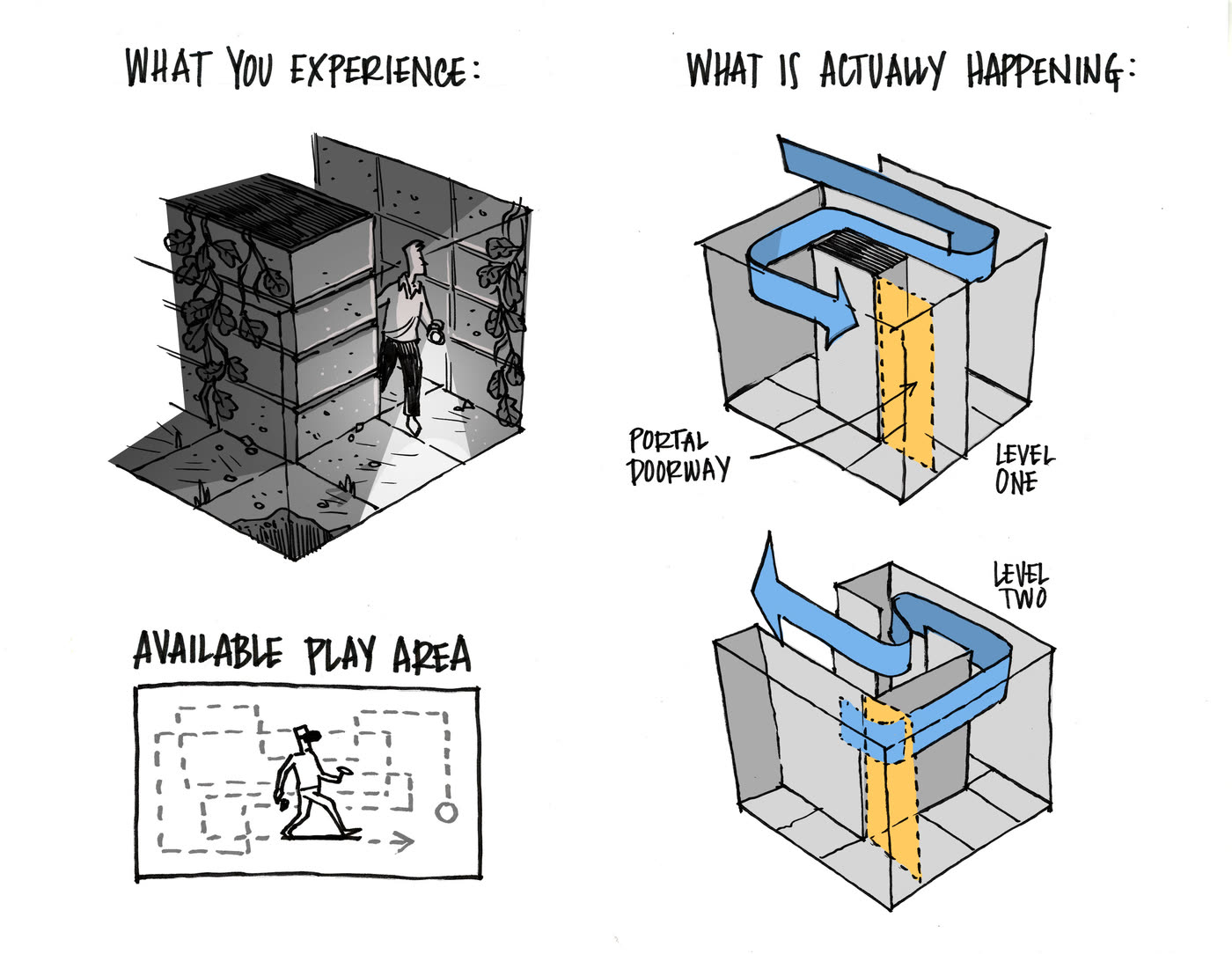
Think of each room as a convincing local bubble. Inside that bubble, the walls, props and scale behave normally. The impossibility emerges only when several bubbles are connected. Two virtual rooms can occupy the same physical coordinates because the player never needs to see both at once. The doorway acts as a seam between them.
In one sentence
Your next virtual room can reuse the physical floor beneath the room you just left. The experience grows, while the real boundary stays where it is.
Overlapping architecture: local truth, impossible whole
The clearest way to understand impossible spaces in VR is to separate local and global layout. Locally, a rectangular gallery can be completely ordinary. Globally, five galleries may be layered over the same three-by-three-metre tracked area, with different entrances, exits and visual identities.
This is why “non-Euclidean VR” is often used as a search term for these experiences. The phrase captures the feeling that ordinary spatial rules have been broken. Technically, implementations vary: some use self-overlapping Euclidean rooms, some transform space at portals, and others dynamically reshape a route. For a player, the useful distinction is simpler: the world no longer has to fit into a single real-world plan.
The transition must protect continuity. A door frame can hide a change until the player commits to the next space. A turn can redirect attention. Lighting and sound can establish the new room before its geometry is fully revealed. The aim is not necessarily to conceal the trick forever; an overt magical portal can make the impossibility the spectacle.
Four techniques that make the world unfold
1. Portals and doorway seams
A portal connects two spaces without requiring a physically possible corridor between them. It may show the destination directly, remain opaque until crossed, or look like an ordinary doorway. Once the frame separates old and new sightlines, the destination can be placed wherever it best fits the tracked floor.
2. Self-overlapping rooms
Self-overlap is the architectural foundation. The designer treats time as another layout dimension: space A occupies the floor now, space B occupies it next. Careful occlusion prevents geometry from both phases being visible together. This produces long houses, towers or stations whose total virtual area is much greater than the physical rectangle.
3. Redirected walking
Redirected walking subtly changes the relationship between the path seen in the headset and the path taken in the room. A virtual corridor may curve differently from the physical path, or the scene may rotate gradually so the player turns before reaching a boundary. It is a broad family of methods, not a synonym for impossible spaces. Both can be combined, but room connections alone can already create substantial reuse.
4. Procedural adaptation
A fixed impossible building can be authored by hand for one play-space size. A procedural system goes further: it selects modules, rotates exits, checks clearance and assembles a compatible route after learning the available dimensions. The result can preserve story beats while changing the geometry that connects them.
Physical walking and artificial locomotion solve different problems
Natural walking
Your real step produces the virtual step. Position, turning and body movement are tracked directly, but the route must respect the play-space boundary.
Joystick movement
A thumbstick can traverse a very large conventional level without physical floor, but movement is generated by input rather than by walking the same distance.
Teleportation
A point-and-jump system crosses distance efficiently. It does not require connected physical footsteps between the start and destination.
Impossible-space walking
The architecture repeatedly reuses a limited floor so real footsteps can continue across a sequence of larger virtual spaces.
No technique is universally correct. A seated interface, a vast outdoor map and an intimate room-scale puzzle have different needs. Impossible spaces are most distinctive when the sensation of physically crossing a threshold is central to the experience.
How traVRsal turns the technique into a platform
traVRsal begins with a room-scale Meta Quest boundary and supports clear rectangular play spaces from 1.5 × 1.5 metres. Worlds describe zones, transitions and placement rules. The runtime fits compatible content to the player’s space, creating routes that may be different in a larger or smaller room.
The technology serves variety rather than one architectural demonstration. Pyramid uses it for a trap-filled descent. SpaceMan turns the same principle into an isolated station. Galleries, action encounters, multiplayer modes and community worlds can all use the engine with different visual and mechanical rules.
That breadth also changes the creator proposition. The public Unity SDK lets designers build modules and mechanics for the system instead of only consuming a fixed campaign. Read the guide to building impossible-space worlds in Unity, or start with the room-scale Meta Quest setup guide if you want to understand the player side first.
Further reading and original research
The design history is broader than any one game. Robert Wetzold’s field research on redirected walking and impossible spaces maps influential projects and techniques that informed traVRsal.
For primary research, see Suma and colleagues’ 2012 paper Impossible Spaces: Maximizing Natural Walking in Virtual Environments with Self-Overlapping Architecture, the 2013 work on Flexible Spaces, and the 2021 comparison VR Natural Walking in Impossible Spaces. These papers use different experiments and vocabulary, but all investigate how limited physical areas can support more extensive walking experiences.
Questions about impossible-space VR
What is an impossible space in VR?
It is a virtual layout whose rooms or corridors overlap in physical coordinates even though they appear separate to the player. The arrangement lets a larger environment reuse a smaller tracked area.
Are impossible spaces the same as non-Euclidean VR?
The terms overlap in everyday game language. Impossible spaces usually describe self-overlapping architecture or connections that cannot exist physically, while non-Euclidean is the broader mathematical and visual label.
How do portals help infinite walking?
A portal creates a controlled transition between locally consistent rooms. After the transition, the next virtual room can occupy floor area that a previous room already used.
Is redirected walking required?
No. Redirected walking is one family of techniques. Impossible architecture can also reuse space through room connections, change-aware transitions and procedural layout choices without continuously rotating the scene.
Can impossible spaces adapt to different rooms?
Yes. A generator can choose compatible room modules, orientations and portal positions after reading the available play-space dimensions.
From theory to footsteps
Walk through the diagram.
traVRsal turns impossible-space research into varied worlds you can explore—and a platform you can build for.